
The year 2011 saw various events -- the Arab Spring, anti- corruption protests, Europe's sovereign debt crisis -- transform countries and reshape the world order. Gateway House, a leading Mumbai-based think tank on India's foreign policy, takes a look at what these events mean for India, and presents India's top foreign policy cheers and jeers for the year.

If you have ever said 'I'll sort retirement later,' now is when 'later' begins.
Pakistani envoys posted in key world capitals, including New Delhi and Beijing, gathered in Islamabad on Monday with top political and military leaders for a meeting that will provide inputs for a proposed foreign policy revamp.

Indian equity benchmark indices Sensex and Nifty experienced a significant tumble in early trade, with the Sensex tanking nearly 700 points, driven by uncertainty surrounding US-Iran negotiations, a fresh spike in crude oil prices, and persistent foreign fund outflows.
Bharatiya Janata Party on Thursday alleged the United Progressive Alliance government's credibility has gone down and internal politics of the alliance adversely affected India's foreign policy as evidenced by India's "failure" to sign a transit treaty with Bangladesh.
If the decade gone by was one that redefined the contours of global politics in the aftermath of September 11, 2001, it was also a decade that witnessed Indian foreign policy coming into its own, writes Harsh V Pant

State Bank of India Chairman C S Setty has expressed support for a 'pause' in policy rates by the Reserve Bank of India's monetary policy committee, believing it will help stabilise conditions and support economic growth. He also urged investors to look beyond short-term equity market movements and focus on India's structural transformation, driven by reforms and digital infrastructure.

Congress leader Rahul Gandhi has called on Prime Minister Narendra Modi to address the escalating conflict between the US, Israel, and Iran, particularly regarding the alleged assassination of the Iranian Supreme Leader. Gandhi emphasised the need for India to uphold international law and advocate for peaceful resolution.

Insights from behavioural economics suggest that an ambitious nudge can be effective if three conditions are met, points out Ram Singh Insights from behavioural economics suggest that an ambitious nudge can be effective if three conditions are met, points out Ram Singh, director, Delhi School of Economics.

The West Bengal government is considering establishing holding centres near the Petrapole border in North 24 Parganas district to manage growing movement and congestion in border areas.

Jammu and Kashmir Police have arrested two individuals for allegedly providing logistical support and shelter to foreign members of the Jaish-e-Muhammad's Saifullah group in Kishtwar district.

For the foreseeable future, the most likely outcome remains continuation of the status quo. Taiwan will remain self-governing without formally declaring independence, while China continues to apply sustained pressure short of war, predict Krishnan Srinivasan and Manoj Mohanka.

'If the war continue for a longer period of time, it is just a matter of time before the government will pass on some of the price increases.'

This could come as a setback to thousands of Indian engineers who have waited for years for their work visas to pave the way for the coveted Green Card.

State-owned enterprises in India are projected to significantly increase their overseas borrowings, potentially exceeding $15 billion in FY27, driven by the Reserve Bank of India's new concessional forex swap facility which offers a 3 per cent funding-cost advantage.

An innovation roadmap, a mechanism to double annual bilateral trade within next five years, and a joint artificial intelligence framework were among 13 outcomes to emerge from wide-ranging talks between Prime Minister Narendra Modi and President Emmanuel Macron on Sunday.

The Reserve Bank of India (RBI) reported a significant 52 per cent year-on-year increase in gains from foreign exchange transactions, reaching 1.69 trillion in FY26. This surge occurred despite the central bank selling a gross $195 billion in the spot market to manage rupee volatility, which saw a 9.85 per cent depreciation.

West Bengal BJP president Samik Bhattacharya has expressed the state government's desire for the Tata Group to return to Singur, viewing it as an economic necessity and a signal that West Bengal is open for business. The move aims to reverse the negative perception created when the Nano project was forced out of the state.
The policy unveiled by the home ministry is based on seven key pillars to counter the terror threats emanating from India or abroad -- prevention, responses, aggregating internal capacities, human rights and "Rule of Law"-based processes.

Foreign tourist arrivals in India dropped to 6.18 million during the April-September 2025 period against 7.06 million during the same period last year, which was a drop of 12.4 per cent.
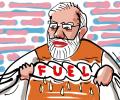
Following through announcements with enforcement of measures is key, as a run through recent Indian economic history shows, points out A K Bhattacharya.
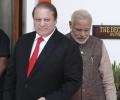
Two years of Modi's foreign policy can be best remembered for its flip-flops on Pakistan and the PM's blockbuster speeches to delirious non-resident communities and the grand receptions he has received.

US Secretary of State Marco Rubio arrived in Kolkata for a four-day diplomatic tour to India, marking the first visit by a US secretary of state to the city in 14 years. His itinerary includes meetings with Indian officials, energy talks, and a Quad Foreign Ministers Meeting.

Amid growing international instability, folks all over the world are wondering if there is any country that can be considered a secure refuge, should this conflict expand into a larger war, drawing in many more nations.

The US government on Friday issued a new policy memo tightening rules for foreign nationals on temporary visas seeking permanent residency, stating that persons wanting a Green Card must return to their home country to apply, except in "extraordinary circumstances".
Allaying fears on the nuclear deal, Congress chief Sonia Gandhi on Thursday said there was no question of compromise on the national security and independent foreign policy.
Delivering the keynote at a conference on The Future of India's Foreign Policy, organized by the University of Pennsylvania, Philadelphia's Centre for the Advanced Study of India, Sen said this was particularly imperative in the context of today's world that is 'shaped by globalization, inter-dependence, inter-connectedness and rapid changes.

Indian stock markets extended their gains for a second consecutive session, with the Sensex closing 736 points higher, driven by a global equity rally and a significant drop in crude oil prices following the finalisation of a peace deal between the US and Iran to end their 107-day conflict and reopen the Strait of Hormuz.

The renewed rush comes days after Chief Minister Suvendu Adhikari announced that West Bengal would aggressively implement a 'detect, delete and deport' policy against infiltrators.

Delhi Police are investigating a blocked roof exit and the use of cooking heaters in guest rooms as key factors in the recent Malviya Nagar hotel fire that killed 21 people. Hotel owner Lavkesh Bajaj has been arrested, and a Look Out Circular issued against his wife, while the manager remains absconding.

If Iran and Oman choose to charge a fee for rendering services to vessels using their territorial waters, so be it. The US is indulging in an irrationally self-destructive act, notes Ambassador M K Bhadrakumar.
"The US was never a friend of India. Friendship with it will bring danger to the country," Dasgupta said.
A suave and sobre politician, Inder Kumar Gujral belonged to that genre of intellectuals who made a mark in the country's foreign policy and a slice of luck catapulted him to the prime minister's office, though briefly.

The United States has redirected 48 vessels in the Persian Gulf, particularly in the Strait of Hormuz, over the past 20 days amid ongoing enforcement actions related to restrictions on Iranian maritime assets by the US Navy.

The Quad grouping has expanded cooperation in critical minerals and energy, while unveiling new measures to boost maritime surveillance and port infrastructure across the Indo-Pacific. This move comes against the backdrop of China's growing military posturing in the region, with ministers reiterating strong opposition to destabilising actions and expressing serious concerns over militarisation of disputed features.


A top Swiss official has emphasised the growing importance of science and technology in international affairs, leading Switzerland to prioritise anticipatory science diplomacy in its foreign policy. Collaboration with India reflects a shared vision between two global innovation leaders.

West Bengal Chief Minister Suvendu Adhikari announced that Bangladeshi infiltrators detained in the state will be handed over to the BSF instead of being produced in courts, following a new rule. Instructions have been issued to the police and RPF to directly transfer detainees to the BSF at the Bangladesh border, with weekly reports submitted to the CMO.

Pope Leo XIV on Monday underscored his commitment to spiritual advocacy over political friction, stating that he has no desire to engage in a confrontation with the US administration.

Few leaders since Independence have been able to establish such a direct connection with the electorate or shape the national conversation to the extent that Narendra Modi has done over the past decade, points out former Union minister Dr Karan Singh.
